
Profile of Similarity of Electron Withdrawing Structure Towards Analgesic-Anti-Inflammatory Activity of The Novel Isatin Analogue: Design and Implementation of Phase I Drug Discovery
Abstract
Isatin (1H-indole-2,3-dione ) and derivatives demonstrate a diverse array of biological activities. Isatin and 5-halo derivatives have reacted to form the schiff’s bases , mannich bases and Friedel-Crafts alkylation’s to form C-C, C-N, C=N bonds. From the spectral studies, isatin has undergone reaction at C-3 and N-1 position and synthesized lead in present scheme and seen the similarity of structure and analgesic-anti-inflammatory activity.
Article Information
- Received
- Accepted
- Published
Academic Editor: Nasim Habibzadeh, Teesside university
Checked for plagiarism: Yes
Review by: Single-blind
Copyright © 2018 Rahul Hajare. et al.
 This is an open-access article distributed under the terms of the Creative Commons Attribution License, which permits unrestricted use, distribution, and reproduction in any medium, provided the original author and source are credited.
Corresponding author: Rahul Hajare, Indian Council of Medical Research, New Delhi —
Competing Interests
The authors have declared that no competing interests exist.
Funding
None
Data Availability
No data-availability statement was provided by the authors.
Acknowledgements
This research work is completed under the supervision and guidance of Renowned Laboratory Scientist, Respected Dr. Ramesh S. Paranjape, Retired Director & Scientist ‘G’ National AIDS Research Institute, India. I express my sincere gratitude towards Respected Sir for motivation and being great knowledge source for this work.
Citation:
Introduction
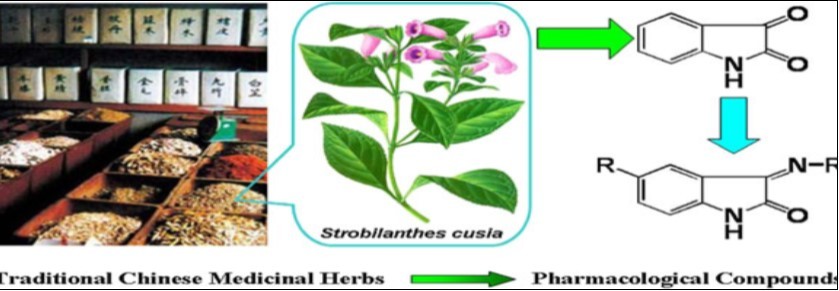
Isatin is a versatile compound isolated in 1988 and reported to possess a wide range of biological activity in mammals. Isatin also is a synthetically versatile substrate that can be used to prepare a large variety of heterocyclic compounds, such as indoles and quinolines, and as a raw material for drug synthesis. Schiff bases and mannich bases of isatin are known to possess a wide range of pharmacological properties including anticonvulsant, antibacterial, antiprotozoal, antifungal, antiviral, anti-HIV, tuberculostatic, analgesic, anticancer activities. In the view of this fact, we have planned the synthesis of some novel isatin analogues and screening them for analgesic-anti-inflammatory activity. Isatin, an extract from Strobilanthes cusia. The roots and the leaves of the plant, Strobilanthes cusia of the Acanthaceae family that is widely distributed in northern and central China, have been used in traditional Chinese medicine to treat a variety of ailments caused by microorganisms and viruses.
Experimental:
Material and Methods
All reagents were obtained from Sigma Aldrich Bangalore, and Loba Chemie, Mumbai. All the solvents used in these studies were dried and distilled before use. Melting points were determined by open capillary tube method and are uncorrected. The purity and homogeneity of the synthesized compound were ascertained by T.L.C. on glass plate using silica gel G as adsorbent and solvent system benzene: ethanol (9:1). The spot was visualized by iodine vapor. The 1H-NMR spectra were recorded on CDCl3 (BRUCKRS). All spectra were obtained from Indian Institute of Technology Pawai Mumbai.
Methodology
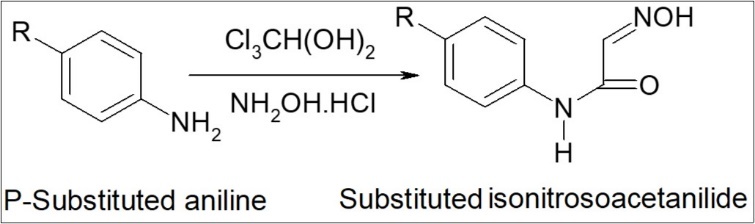
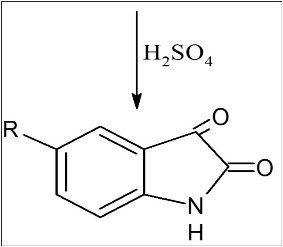
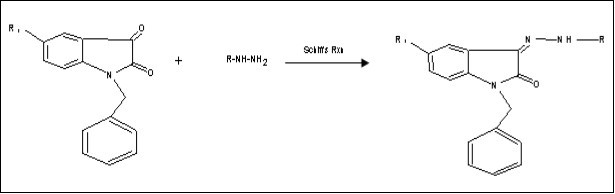
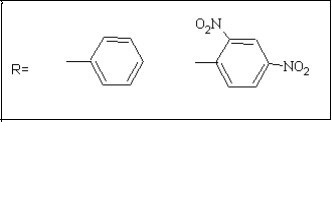
Lab Scale R & D
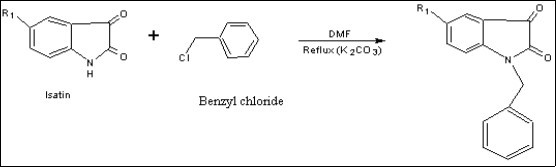
Methods of Preparation of 5-substituted N-benzyl isatin derivatives: 6
Equimolecular quantity of isatin and benzyl chloride was taken in RBF. To this mixture 20 ml of dimethyl formamide and potassium carbonate were added. After gently shaking the mixture refluxed for 2hrs. The mixture was cooled and poured into the 100 ml of ice cold water. The resultant orange colour precipitate was collected and washed with water. After drying it was recrystallized from ethanol. M.P. is1200C-1300C 1, 2.
Methods of Preparation of Schiff’s bases of 5-substituted N-benzyl isatin derivatives:
Equimolecular quantity of N-benzyl derivatives and amines was added into 20ml of absolute ethanol in 250 ml of round bottom flask. In this mixture few drops of glacial acetic acid were added. The reaction mixture was refluxed for 2-3 hour extended and checked for completion through visual procedure. After completion of reaction the mixture was placed for 24 hour, filtered and recrystallized from ethanol 3, 4. (Table 1)
Table 1. List of compounds| CODE | COMPOUND | TEXTURE |
|---|---|---|
| P-01 |
|
Yellow crystalline |
| P-02 |
|
Orange crystalline |
| P-03 |
|
Yellow shiny crystalline |
| P-04 |
|
Orange crystalline |
| P-05 |
|
Red-orange crystalline |
| P-06 |
|
Brown crystalline |
| P-07 |
|
Red orange crystal |
| P-08 |
|
Brown |
| P-09 |
|
Yellow crystalline |
| P-10 |
|
Yellow crystalline |
| P-11 |
|
Yellow crystalline |
Preliminary Pharmacological Screening
Acute Toxicity Studies, Cut-off LD50
LD50 of test compounds was performed at Anuradha College of Pharmacy Chikhali as per the O.E.C.D. guideline. Test compounds were suspended in 1% CMC solution. The compounds were administered orally at a dose level of 300,500 and 1000 mg/kg body weight, to groups of 6 animals. After administration of test compounds the rats were observed for gross behavioral neurological autonomic and toxic effects. The toxicological effects were observed in terms of mortality. No death occurred within 24 h of dose of 300 and 500mg/kg but at a dose of 1000mg/kg 50% mortality was observed. As dose has increased further up to 4000mg/kg, all the animals have died. Hence 1000 mg/kg dose was considered as LD50. 1/10th of the LD50 was considered as an effective dose i.e.100 mg/kg.
Evaluation of Analgesic Activity. (Writhing test)
The method has followed described by International standards. The total number of writhing following intraperitoneal administration of acetic acid solution (1%, 10 ml/kg) was recorded over a period of 30 min, starting 5 min after acetic acid injection. The mice were treated with test (100 mg/kg) suspended in 1% CMC or standard drug (Aspirin, 300 mg/kg), 30 min before administration of acetic acid 5.
The number of writhings and stretching was recorded and permitted to express the percentage of protection using the ratio = (Control mean-treated mean) ×100/control mean
Carrageenan-Induced Hind Paw Edema in Rats.
The acute hind paw edema was produced by injecting 0.1 ml of Carrageenan (prepared as 1% suspension in 1% CMC) locally into the plantar aponeurosis of the right hind paw of rats, to groups of six ,and standard drug, acetylsalicylic acid (ASA, 300 mg/kg), respectively. Test (drug 100 mg/kg) and ASA were administered 1 h prior to the injection of Carrageenan. The rat pedal volume up to the ankle joint was measured using plethysmometer at 0 h (just before) and 1h and 3 h after the injection of Carrageenan. Increase in the paw edema volume was considered as the difference. Percent inhibition of edema volume between treated and a control group was calculated as follows:
Percent inhibition = (Vc − Vt)/Vc × 100, Where Vt = mean relative change in a paw volume in test group and Vc = mean relative change in paw volume in control group.
Result and Discussion
The all synthesized compound was analyzed by 1H-NMR spectra on CDCl3.The reproducibility of the developed method was ascertained by considering the physical properties of the synthesized compound.
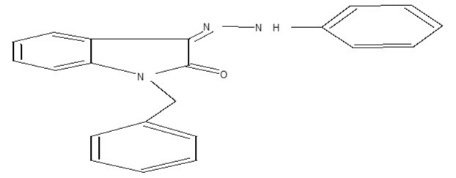
N-benzyl 3-(phenylimino)-1,3-dihydro-indole-2one (P-01)
Yield 70%, m.p.2600C, Rf value 0.6, 1H-NMR (1H) =N-NH d 12.82, (4-H) d 7.6, (2 Ar-H) N-CH2 d 6.6.
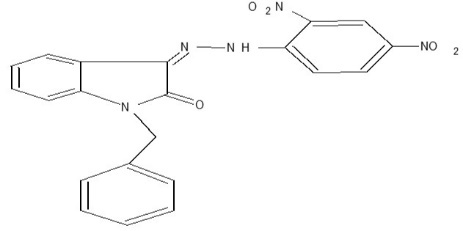
N-benzyl 3-[(2, 4 -dinitrophenylimino)-hydrazono]-1, 3-dihydro-indole-2-one (P-02)
Yield 70%, m.p. >3000C Rf value 0.53, 1H-NMR (1H) =N-NH d 12.82, (4-H ) d 7.6, (2 Ar-H) N-CH2 d 6.6.
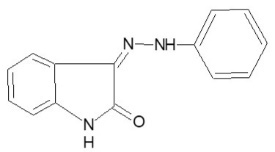
3-[(phenylimino)-hydrazono]-1,3- dihydro-indole-2-one (P-03)
Yield 76%,m.p.>2200C,Rf value 0.46. 1H-NMR (1H) =N-NH d 12.7, (4-H) d 7.8, (4 Ar-H) d 7.3.
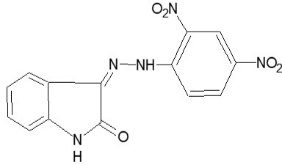
3-[(2, 4 -dinitro-phenylimino)-hydrazono]-1,3- dihydro-indole-2-one (P-04)
Yield 80%,m.p. >2900C, Rf value 0.5. 1H-NMR (1H) =N-NH d 12.15, (4-H) d 8.5, (2 Ar-H) d 7.4.
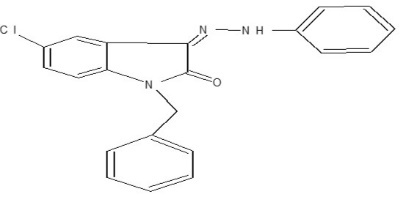
N-benzyl 3-(phenylimino)-5-Chloro-1,3-dihydro-indole-2-one (P-05)
Yield 40%, m.p. >3000C Rf value 0.7. 1H-NMR (1H) =N-NH d 12.8, (3-H) d 7.6 , (4 Ar-H) d 7.3, (2H) N-CH2 d 6.6.
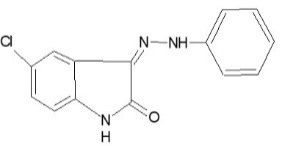
3-[(phenylimino)-hydrazono]-5chloro-1,3-dihydro-indole-2-one (P-06)
Yield 70%, m.p. >3000C Rf value 0.53. 1H-NMR (1H) =N-NH d 11.14, (3-H) d 7.5 , (4 Ar-H) d 7.3.
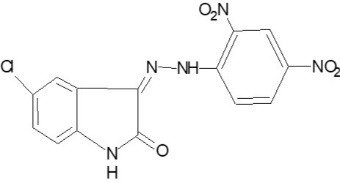
3-[(2, 4 -dinitro-phenylimino)-hydrazono]-5Chloro-1,3-dihydro-indole-2-one (P-07)
Yield 80%, m.p. >3500C Rf value 0.52. 1H-NMR (1H) =N-NH d 9.4, (3-H) d 8.3, (3 Ar-H) d 7.3.
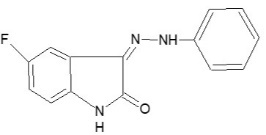
3-[(phenylimino)-hydrazono]-5 Fluro-1,3-dihydro-indole-2-one(P-08)
Yield 45%, m.p. 2700C Rf value 0.9. 1H-NMR (1H) =N-NH d 12.7, (3-H) d 7.6, (4Ar-H) d 7.3.
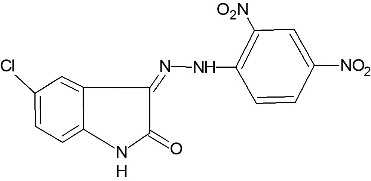
3-[(2, 4 -dinitro-phenylimino)-hydrazono]-5 Fluro-1,3-dihydro-indole-2one (P-09)
Yield 50%, m.p. >3500C Rf value 0.51. 1H-NMR (1H) =N-NH d 12.7, (3-H) d 7.6, (2Ar-H) d 7.3.
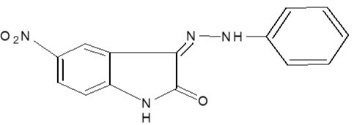
3-[(phenylimino)-hydrazono]-5 Nitro-1,3-dihydro-indole-2-one (P-10)
Yield 72%, m.p. 3000C Rf value 0.9. 1H-NMR (1H) =N-NH d 12.7, (3-H) d 7.6, (2 Ar-H) d 7.3.
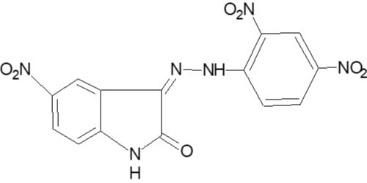
3-[(2, 4 -dinitro-phenylimino)-hydrazono]-5 Nitro-1,3-dihydro-indole-2-one (P-11)
Yield 80%, m.p. >3500C Rf value 0.5. 1H-NMR (1H) =N-NH d 9.4, (3-H) d 8.5, (3 ArH) d 7.5.
In the present study, new Schiff’s bases of 5-substituted N-benzyl isatin derivatives have been synthesized and their anti-inflammatory and analgesic activities were evaluated against standard drug. The anti-inflammatory activity of the compounds was examined by using carrageenan induced rat paw oedema method and analgesic activity by Writhing test. The test compound P-01, P-02, P-06 and P-08 exhibit statistically significant at 3 hrs. Except P-03 .However the effect was comparable to aspirin at 3 hrs. (Table 2)
Table 2. Carrageenan Induced Rat Paw Oedema Method| Group | Test Material (dose) | Mean increase in paw volume + Standard deviation and % inhibition | ||
| 0 hr. | 1 hr. | 3 hr. | ||
| 1. | Control | 1.1 + 0.17 | 1.40 + 0.12 | 1.70 + 0.14 |
| 2. | Standard (Aspirin 300mg/kg) | 1.1 + 0.12 | 1.3 +0.12 (33%) | 1.4 + 0.14 (50 %) |
| 3. | P-01 (100mg/kg) | 1.2 + 0.12 | 1.4 + 0.14 (33%) | 1.5 + 0.14 (50%) |
| 4. | P-02 (100mg/kg) | 1.00+ 0.16 | 1.3+ 0.16 (00%) | 1.5 + 0.14 (16 %) |
| 5. | P-03 (100mg/kg) | 1.2 + 0.14 | 1.4 + 0.14 (33%) | 1.4 + 0.14 (33%) |
| 6. | P-06 (100mg/kg) | 1.1 + 0.10 | 1.3 + 0.12 (33%) | 1.3 + 0.4 (33%) |
| 7. | P-08 (100mg/kg) | 1.00 + 0.14 | 1.2 + 0.14 (33%) | 1.3 + 0.17 (50%) |
The results are expressed as MEAN (+ S.D.) from six observations. One way ANOVA is followed by Dunnet’s t- test. Group II ndto VIIth is compared with group I st (control). (P< 0.01); * = not significant (for 3 hrs.). No-one compound is significant at 1 hrs (P= 0.O74). (Figure 1) (Table 3)
Figure 1. Carrageenan Induced rat paw edema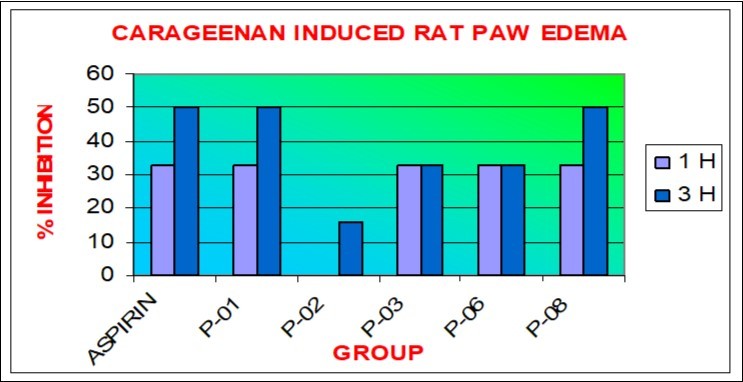
Download figure
| S.N. | Group (Dose) | Response time ( + s.d. ) | No. of Writhing ( + s.d. ) | % Inhibition in Writhing |
| 1. | Control | 2.37 (0.33) | 59.83 (2.31) | ---------- |
| 2. | Standard (Aspirin 300mg/kg) | 5.54(0.41) | 15.85(2.63) | 73 |
| 3. | P-01 (100mg/kg) | 7.76(0.94) | 18.50(1.87) | 69 |
| 4. | P-02 (100mg/kg) | 3.13(0.33 | 46.66(1.60) | 22 |
| 5. | P-03 (100mg/kg) | 4.35(0.37) | 35.83(1.16) | 40 |
| 6. | P-06 (100mg/kg) | 4.85(0.27) | 32.83(1.16) | 45 |
| 7. | P-08 (100mg/kg) | 5.42(0.60 | 29.33(2.42) | 50 |
The results are expressed as mean (+ S.D.) from six observations. One way ANOVA is followed by Dunnet’s t- test. Group II ndto VIIth is compared with group I st (control).(P< 0.01); and are significant (Figure 2)
Figure 2. % inhibition of acetic acid induced writhing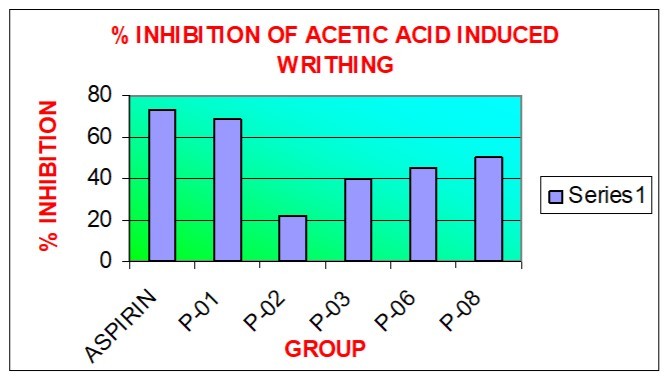
Download figure
Conclusion:
The experiments reported here from results of biological activity of the compounds there is a clear cut relation of compounds with each other due to structural similarity. A compound with N-benzyl-3-substituted isatin was synthesized using appropriate synthetic route and screened for analgesic and anti-inflammatory activity.The test compounds showed significant anti-inflammatory and analgesic activity compared with the standard drug Aspirin. The study of the structure-activity relationship reveals that the presence of the electron withdrawing group does not affect anti-inflammatory activity and increase in electro-negativity increases the analgesic activity. (Table 4)
Table 4. Comparative study of the activity| S.N. | Compound | R | R I | Activity | |
|---|---|---|---|---|---|
| Analgesic | Anti-Inflammatory | ||||
| 1 | P-01 | C6H5 | H | 69 | 50 |
| 2 | P-02 | C6H4N202 | H | 22 | 16 |
| 3 | P-03 | H | H | 40 | 33 |
| 4 | P-06 | H | Cl | 45 | 33 |
| 5 | P-08 | H | F | 50 | 50 |
This article belongs to the Public Health. The experimental data and analysis part is very sufficient, and the conclusion is very reasonable. It is recommended to publish the article in your esteemed journal. I hope this helps.
Disclosures
Animal ethical approval
Abbreviations
- 1H-NMR: Proton nuclear magnetic resonance
References
- 1.Hajare Rahul, Paranjape Ramesh, Kulkarni Smita. Tailored microwave technology for Synthesis N-[(3Z)-5-chloro-1-(morpholin-4-ylmethyl)-2-oxo-1,2-dihydro-3H-indol-3 ylidene. pyridine-4 carbohydrazide as HIV-1 inhibitors.(2016) Drug Formulation & Bioavailability Congress” September 05-07 , Beijing, China .
- 2.Hajare Rahul, Paranjape Ramesh, Kulkarni Smita. (2016) Technology development and design of novel 1, 3, 5-tri substituted-1H-indole-2, 3-dione: HIV-1 Inhibitors with displays strategic nanomolar cytotoxicity. 251stACS National Meeting & Exposition held on March 13-17,2016 in , San Diego, CA, USA .
- 3.Hajare Rahul, Kulkarni Smita, Thakar Madhuri, Paranjape Ramesh. (2016) . Technology Development and Design of Novel 1, 3, 5-tri Substituted-1H-Indole-2, 3-Dione HIV-1 Inhibitors With Displays Strategic Nanomolar Cytotoxicity , World J Pharm Pharm Sci.; 5(6), 391.
Cited by (5)
This article has been cited by 5 scholarly works according to:
Citing Articles:
Noor Waleed, Ibrahim, M. Mahdi, Ayad M. R. Raauf - Iraqi Journal of Pharmaceutical Sciences (2025) Semantic Scholar
N. Ibrahim, M. Mahdi, Ayad M. R. Raauf - Materials Today: Proceedings (2021) Semantic Scholar
Materials Today: Proceedings (2021) Crossref OpenAlex
Rahul Hajare - Organic & Medicinal Chemistry International Journal (2018) Semantic Scholar
International Physiology Journal (2018) OpenAlex